
An Indian Ringneck is a grain and fruit eater from the orchards and crop fields of Asia, and most of the ones living in Australian homes are being fed a bowl of sunflower heavy parrot mix. Feeding the bird you actually have means a pellet and vegetables as the base, a seed blend made for Asiatic parrots on top, and the rich stuff rationed.
Ringnecks are also famously set in their ways, so this guide spends as much time on getting new food accepted as on what the food should be.
Jump to How the Bowl Should Be Split, Pellets, Vegetables and Fruit, Seed Blends, Soaked Seed, Sprouts and Nuts, Treats, Fussy Eaters or Common Questions.
What Do Indian Ringnecks Eat in the Wild?
Wild Ringnecks range from Pakistan and India through to Southeast Asia, and they are known there as raiders of grain crops and fruit orchards. Their natural diet is a mix of seeds, grain, ripe and unripe fruit, figs, flowers, buds and greens, taken high in trees and low in fields depending on the season. What it is not is a year round supply of oil seed.
That matters for the bird on your shoulder. A Ringneck is built to handle a wide range of foods and to spend a good part of the day working for them, which is why a bird given only a dry seed mix tends to eat the sunflower, bin the rest and then go looking for something to chew.
How Should an Indian Ringneck's Bowl Be Split?
A workable daily routine for a pet Ringneck looks like this. Pellets available through the day, a fresh serve of vegetables in the morning with a little fruit, and a measured amount of a good seed blend rather than a bowl kept permanently full. Nuts and treats come out of your hand or a foraging toy, not the dish.
The exact split depends on the bird. One that already eats pellets can have seed as a smaller part of the day. One coming off a lifetime of parrot mix will need seed to stay the main thing it recognises for a while, with the rest introduced around it. Either way, measure the seed so you know what has actually gone. A Ringneck husks every seed neatly and drops the shell back in the bowl, so a dish that looks untouched can be mostly empty hulls. Blow across the top before you decide your bird is off its food.
Shape counts too. Ringnecks hold food in one foot and work on it, and a chunk they can grip usually gets more attention than a fine chop. That applies to vegetables, fruit, nuts and even pellets, which is worth remembering every time something new is refused.
Which Pellet Suits an Indian Ringneck?
A pellet earns its place because every piece is the same. There is nothing in it to pick out and nothing to leave behind, which is exactly what a selective eater like a Ringneck needs somewhere in the diet.
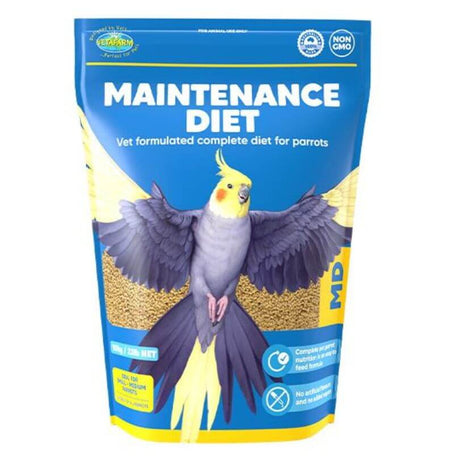
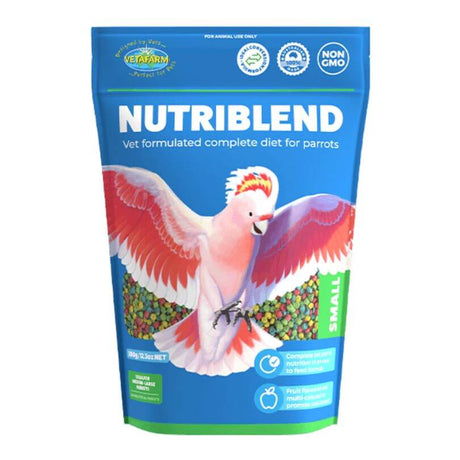
The Vetafarm Nutriblend Small Pellet is a fruit flavoured pellet made for starting birds on a pelleted diet, and the Small size is the one that suits Indian Ringnecks and Alexandrines. Its own listing says it was formulated by avian vets and is used in store. The 350g bag is the sensible first buy, with 2kg and 10kg once your bird has decided pellets are food.
The Parrot Deli Maintenance Pellet 4mm is Australian made from wheat, lupin, soy and alfalfa with added vitamins, trace minerals and amino acids, plus seaweed meal, spinach leaf powder and rosemary extract, and no artificial colours. It lists Ringnecks and Alexandrines and comes in a 1kg pack. If your bird is on the Basic Parrot Seed Blend, this is the pellet already blended through the seed and pellet version of it, so it may be a face your bird has met.

Vetafarm Nutriblend Small Pellet |

Parrot Deli Maintenance Pellet 4mm |
Vetafarm Nutriblend Small Pellet and Parrot Deli Maintenance Pellet 4mm.
Two others are worth knowing about. Harrisons Adult Lifetime Fine is the certified organic option in the size that suits a Ringneck, and Tropican Lifetime Formula 4mm Granules list Ringnecks and Alexandrines among the birds they are made for. The whole range is in the pellets collection.
How Long Does It Take a Ringneck to Accept Pellets?
Anywhere from a few days to a couple of months, and a Ringneck is more likely to be at the slow end. Mix a small amount through the seed so pellets are simply part of what the bowl contains, offer a few crushed over warm vegetables so they pick up the flavour, and try a single pellet held out in your fingers, since a bird that will not eat from a dish will sometimes take something from your hand out of pure curiosity.
Keep the familiar seed available while this is going on. Taking it away to force the change can leave a Ringneck eating almost nothing for days, and that is a bigger problem than a slow conversion. Watch the weight and the droppings, and if either changes noticeably, slow down. Our article on whether your bird will actually eat pellets goes into the method in more detail.
What Vegetables and Fruit Should a Ringneck Get?
Given where they come from, fresh food is not an extra for a Ringneck. It is a good part of what the bird would be eating anyway.
Vegetables go in every day. Corn on the cob cut into wheels, capsicum in strips, carrot in batons, broccoli by the floret, snow peas whole, and leafy greens such as silverbeet and kale left in big pieces all give a Ringneck something to hold. Pumpkin and sweet potato are better lightly cooked. Fruit is welcome in smaller amounts: apple with the seeds removed, pear, stone fruit with the stone out, berries, melon and a piece of fig when they are in season. Anything left after a few hours comes out, and on a hot Brisbane day that can mean by late morning.
Chilli deserves its own line because it is the fresh food most Ringnecks fall for first. Birds lack the receptors that make chilli hot for us, so a whole fresh chilli or a couple of Raw for Birds Dried Chillies can go in the bowl or a foraging toy without worry. Wash your hands afterwards.
For the full lists, see our guides to safe vegetables, safe fruit and safe herbs, spices and flowers, or the 200 safe and toxic foods guide when you are standing at the fridge unsure.
Freeze Dried and Home Grown Options
Freeze dried produce does not go off in a warm cage and it fits in a foraging toy, which makes it useful for the days fresh chop is not practical. Raw for Birds makes their Freeze Dried Seasonal Chop from fruit and vegetables bought at the Brisbane markets each week, then washed, prepared and freeze dried, and it can be fed dry or rehydrated. Beak Joy Freeze Dried Seasonal Vegetables and Beak Joy Freeze Dried Seasonal Fruit and Vegetables come in 30g bags. Our guide to freeze dried food covers serving and storage.
If greens keep getting refused, grow them. The Raw for Birds Bird Microgreens Grow Kit raises broccoli, kale, radish or mixed microgreens on a windowsill in a week or two, and a Ringneck that ignores a broccoli floret will often tear into a whole tray of broccoli shoots.
Which Seed Blend Is Made for Indian Ringnecks?
Seed stays in the diet, in a measured amount, and the blend you choose decides how much of it your bird actually eats. A supermarket parrot mix is mostly sunflower, safflower and a few grains, and a Ringneck will take the sunflower and leave you a bowl of everything else. We sell three blends made for Asiatic parrots, and they go about it differently.
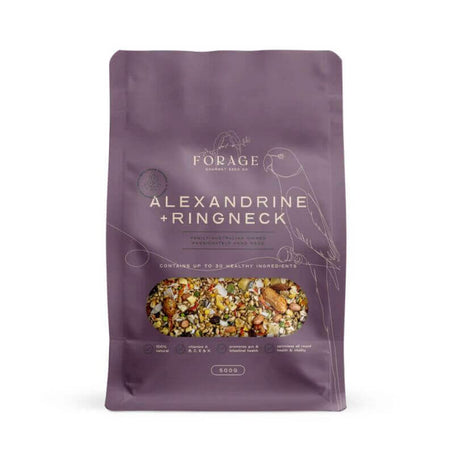
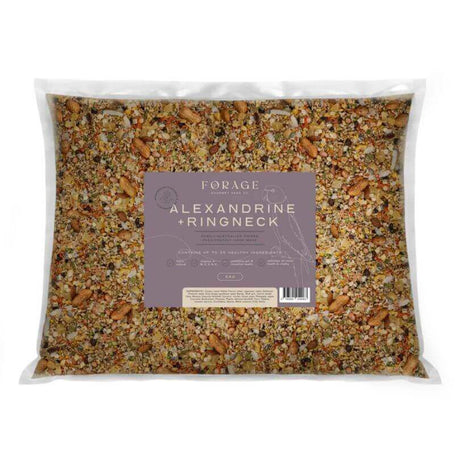
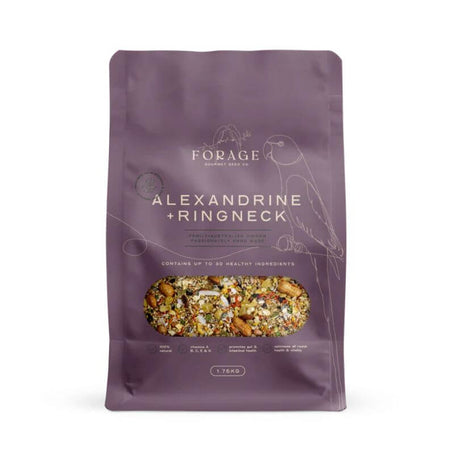
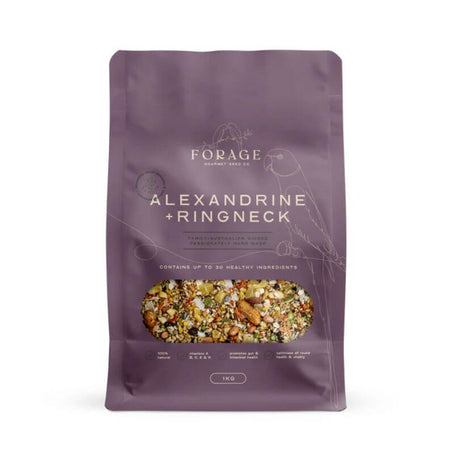
The Forage Gourmet Alexandrine and Ringneck Blend was made for these two species and no others. Its idea is size range: big and little fruits, vegetables, nuts and seeds in the same bag, so there is always a large piece to hold and small seed to sift through afterwards. It comes in 500g, 1kg, 1.75kg and 5kg bags.
"I've been feeding my Indian Ringneck, Rio, the Forage Alexandrine and Ringneck blend for a couple of years now, and it has been the perfect supplemental feed for him. The quality of the mix is excellent, and he enjoys foraging through the blend."
Julie K., verified buyer, Forage Gourmet Alexandrine and Ringneck Blend. Bought for an Indian Ringneck.
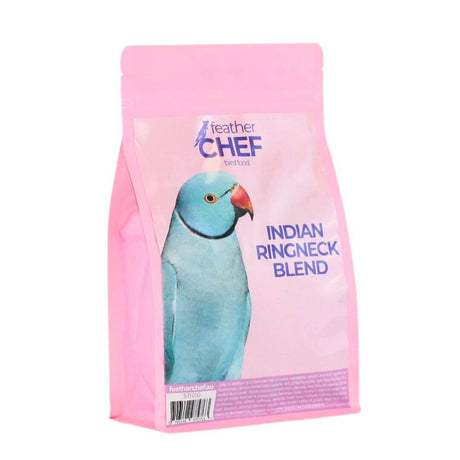
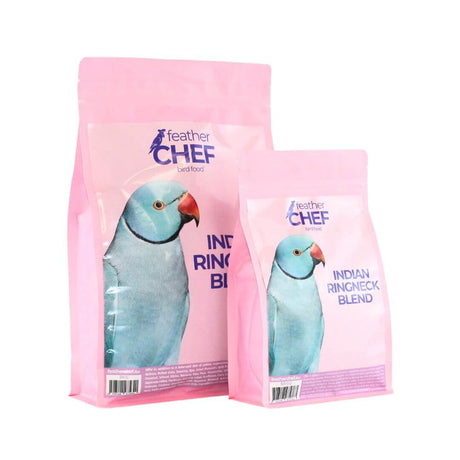
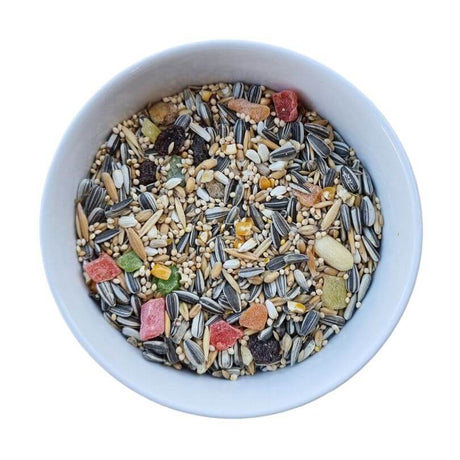
The Feather Chef Indian Ringneck Blend starts from millet and grains rather than oil seed, mixes small and large seed in the base, then adds fruit, nuts, spices and dried pumpkin and finishes with a dusting of dandelion leaf and vegetable powders. There are no fillers and no shell grit. The pack lists Alexandrines, Plum Heads, Moustache, Malabar and Derbyan Parrots alongside Ringnecks, and it says to feed it into your bird's existing seed with pellets, sprouts and vegetables, which is the right instruction for any blend here. Sizes are 500g, 2kg and 4.5kg.
"I've been buying this bird seed for about 2 years now for my two Indian Ringnecks, and I couldn't be happier with it. The mix has a great variety of seeds and dried fruits, which keeps them interested and excited at feeding time."
Danielle H., verified buyer, Feather Chef Indian Ringneck Blend. Bought for Indian Ringnecks.
The Raw for Birds Indian Parrot Seed Blend is the one to reach for if sunflower is the problem you are trying to solve. It is a low sunflower mix of natural seeds with edible flowers and herbs such as chamomile, calendula and parsley, and almonds in the shell for the bird to crack. Raw for Birds say plainly on the pack that it is not a complete diet and belongs alongside pellets and fresh food. It suits Indian Ringnecks, Alexandrines, Plum Heads, Malabars and Moustache Parrots and comes in 500g, 2kg and 4.5kg bags.
"High-quality food that my three IRN love. Thank you."
magda o., verified buyer, Raw for Birds Indian Parrot Seed Blend. Bought for Indian Ringnecks.

Forage Gourmet Alexandrine and Ringneck Blend |

Feather Chef Indian Ringneck Blend |

Raw for Birds Indian Parrot Seed Blend |
Forage Gourmet Alexandrine and Ringneck Blend, Feather Chef Indian Ringneck Blend and Raw for Birds Indian Parrot Seed Blend.
Pick by what your bird needs. A Ringneck that gets bored and starts flinging seed does well on the Forage for the range of piece sizes. A bird that has only ever eaten grain based parrot mix often accepts the Feather Chef first because millet and grain are what it already knows. A bird carrying weight, or one that lives on sunflower, is the case for the Raw for Birds. Many owners keep two on the go and alternate.
Feeding a Pair or an Aviary
Gourmet blends get expensive by the bucket. The Basic Parrot Seed Blend is a plain Australian mix for Ringnecks and Alexandrines in 1kg packets, sold as seed alone or with Parrot Deli maintenance pellets already blended through, and it stretches any of the three blends above without losing the fruit, nuts and vegetable pieces that make them worth buying. Whatever you are not feeding this week goes in the freezer, and our guide to storing bird seed explains why.
What About Soaked Seed, Sprouts and Nuts?
These three sit between seed and fresh food, and for a Ringneck they do two jobs at once: more variety in the diet and more work to get at it.
Soaking is the easy one. The Raw for Birds Chunky Soaking Blend is thirteen larger seeds, grains and legumes with organic almonds through it, made on the idea that bigger parrots try foods they can see and pick up, and it lists Indian Ringnecks and Alexandrines. Sprouting takes a day or two longer and lets the seed germinate. The Raw for Birds Sprouting Blend is seven organic grains, beans and legumes, and the Sunflower Free Sprouting Blend is the same idea for a bird that gets its sunflower elsewhere. Both are wet foods, so rinse well, use clean containers, clear leftovers in warm weather and throw out any batch that smells sour or looks slimy. Our soaking guide and sprouting guide cover the method.
Nuts are for foraging, not for filling up on. The rule is to match the shell to the beak. Almonds in shell and hazelnuts in shell both list Conures and up, and a Ringneck can open either once it has worked out the trick. Peanuts in shell are roasted and much easier to crack, so they are the place to start with a bird that has never met a nut. Walnuts and pecans list Cockatoos and up, so crack one yourself and hand over a piece rather than leaving a whole one in the cage. For nuts mixed with other things, Raw for Birds Aketi's Forage Treat is fifteen nuts, fruits, flowers and seeds with whole cinnamon sticks, star anise and almonds in the shell through it, and it lists Ringnecks and Alexandrines. Our guide to safe nuts and seeds explains why roasted peanuts and not raw, and how much is reasonable.
How Do I Give a Ringneck Treats Without Overdoing It?
Ringnecks train well because they are food motivated, and that cuts both ways. Keep treats for training, step up work and foraging toys, and keep them out of the food dish.
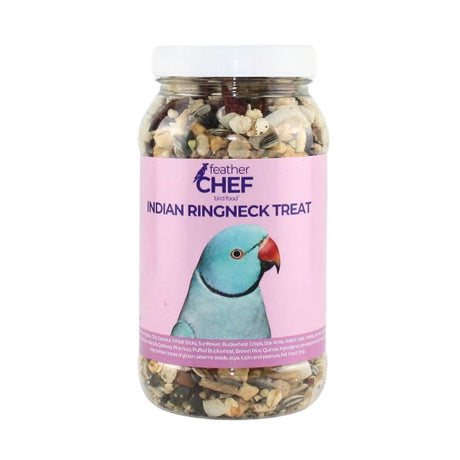
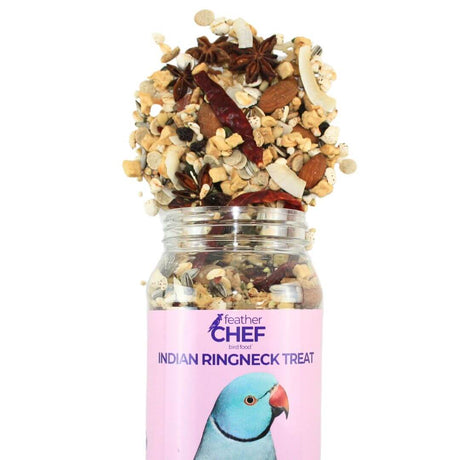
The Feather Chef Indian Ringneck Treat is seeds, fruit, nuts, herbs and spices with crunchy nuts, apple and toasted buckwheat, and the jar spells out the dose: one teaspoon, one or two times a week, in a foraging toy or during training. Use that as the yardstick for everything else in this section. It comes in 350g and 900g jars.
"Packed with great, nutritious seeds, nuts and fruit, our ringneck loves it."
Kathleen S., verified buyer, Feather Chef Indian Ringneck Treat. Bought for an Indian Ringneck.
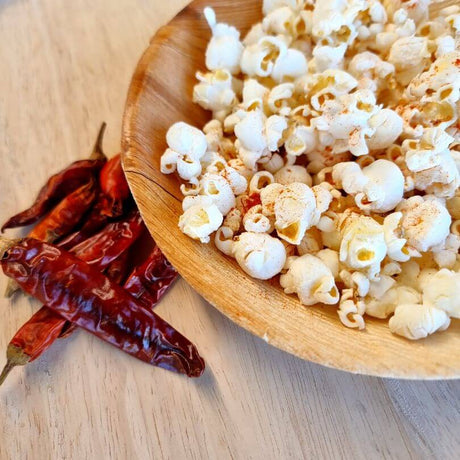
The team at Raw for Birds pop their Parrot Popcorn fresh to order, with no added fats, oils or artificial flavours and a light dusting of cayenne, beetroot or spinach. It is a one or two pieces a day treat, and a Ringneck holding a piece of popcorn in one foot is a good way to spend five minutes.
For something that lasts, the Forage Parrot Pinecone Treats are a natural pinecone rolled in seed, oats, carrot and coconut with a hook to hang it, and the Medium is the Ringneck size. Raw for Birds Banksia Nibbles are a seed coated banksia pod on a jute rope, and the Raw for Birds Tropical Treat is dried fruit and flowers for scattering through a foraging tray. More in the treats collection.

Feather Chef Indian Ringneck Treat |

Raw for Birds Aketi's Forage Treat |

Forage Parrot Pinecone Treats |
Feather Chef Indian Ringneck Treat, Raw for Birds Aketi's Forage Treat and Forage Parrot Pinecone Treats.
Why Won't My Ringneck Try Anything New?
Because it is a Ringneck. Of all the parrots we deal with in the shop, this is the one owners most often describe as refusing everything for weeks and then, one morning, eating it as though it had always been there. A few things shorten the wait.
Present food in a shape the bird can hold. A whole snow pea, a corn wheel or a carrot baton gets picked up out of curiosity where a chop gets ignored. Serve the new thing first, in the morning, before the seed goes in, when the bird is hungriest. Mix a little through what it already eats rather than swapping the dish over. Eat some of it yourself where the bird can watch, slowly and with obvious enjoyment; Ringnecks pay close attention to what the flock is eating. And keep putting it in, every day, without fuss. Removing it after three refusals teaches the bird that refusing works.
If your bird's answer to new food is to tip the whole dish onto the floor, our article on why birds tip their food bowl covers the causes and the bowls that stop it.
Calcium, Grit and Weight
Cuttlebone and mineral blocks give a Ringneck something hard to chew and a little calcium on the side. Mineral Nibblers combine a mineral block with beads and list Ringnecks and Alexandrines, and the cuttlebone and mineral range has plainer options. A bird eating a suitable pellet is probably getting the calcium it needs already, so treat these as chew items rather than a supplement, and take any real worry about calcium or egg laying to an avian vet. Shell grit is not needed, since a Ringneck husks its seed before swallowing it.
On weight, the scale only tells part of the story. Body condition matters as much, and an avian vet can feel the keel and tell you whether your bird is carrying fat. If the advice is to cut back, the low sunflower Raw for Birds blend above is the easy first move, along with measured portions, more pellet and vegetable in the bowl, fewer nuts, and more chances to fly and climb.
What Should a Ringneck Never Be Given?
Avocado, chocolate, caffeine, alcohol and onion, along with salty, sugary or processed human food. Take the stone out of stone fruit and the seeds out of apples, and throw away anything mouldy, including seed that has sat open in a warm cupboard.
Common Indian Ringneck Feeding Questions
What should an Indian Ringneck eat every day?
A suitable pellet, fresh vegetables with a little fruit, and a measured amount of a seed blend made for Asiatic parrots. Nuts and treats are for training and foraging, not the dish.
Is seed bad for Indian Ringnecks?
Seed on its own is the problem, not seed itself. A plain parrot mix lets a Ringneck live on sunflower, which is high in fat and short on everything else. A varied Asiatic blend, fed in a measured amount alongside pellets and vegetables, is fine.
Which pellet is best for an Indian Ringneck?
Vetafarm Nutriblend Small Pellet and Parrot Deli Maintenance Pellet 4mm both suit Ringnecks and Alexandrines. Harrisons Adult Lifetime Fine and Tropican Lifetime 4mm are also made in a size that fits. Start with a small bag and mix it through the seed.
How do I get my Ringneck to eat pellets?
Mix a few through the seed, crush some over warm vegetables, offer one from your fingers, and keep the familiar seed available while you wait. It can take days or a couple of months. Never withhold food to force it.
What vegetables can Indian Ringnecks eat?
Corn, capsicum, carrot, broccoli, snow peas, silverbeet, kale, pumpkin and sweet potato are all good, and chilli is usually the first thing a Ringneck accepts. Cut them large enough to hold in one foot.
Can Indian Ringnecks eat fruit?
Yes, in smaller amounts than vegetables. Apple with the seeds removed, pear, berries, melon, stone fruit with the stone out and fresh fig all suit them. Remove leftovers before they spoil.
Can Indian Ringnecks eat chilli?
Yes. Birds do not have the receptors that make chilli hot for people, so fresh or dried chilli can go in the bowl or a foraging toy. Wash your hands afterwards.
Which seed blend is made for Indian Ringnecks?
Forage Gourmet Alexandrine and Ringneck Blend, Feather Chef Indian Ringneck Blend and Raw for Birds Indian Parrot Seed Blend are all made for Asiatic parrots. Forage has the widest range of piece sizes, Feather Chef is built on millet and grain, and Raw for Birds keeps the sunflower low.
Can Indian Ringnecks eat nuts?
Yes, as a foraging treat rather than a daily food. Almonds and hazelnuts in shell suit a Ringneck, roasted peanuts in shell are the easy starting point, and walnuts and pecans should be cracked open first.
Can Indian Ringnecks eat soaked or sprouted seed?
Yes. The Raw for Birds Chunky Soaking Blend lists Indian Ringnecks, and either sprouting blend suits them. Treat it as a wet food: rinse well, remove leftovers promptly and discard anything that smells sour.
How much treat is too much for a Ringneck?
The Feather Chef Indian Ringneck Treat jar says one teaspoon, one or two times a week, and that is a fair limit for most treats. Popcorn is one or two pieces a day.
Why does my Ringneck throw its food on the floor?
Sometimes boredom, sometimes searching for the sunflower, sometimes a dislike of the dish itself. A blend with more variety, a measured portion and a bowl that clips firmly to the cage all help.
Do Indian Ringnecks need grit or cuttlebone?
Not grit, because they husk their seed before swallowing it. Cuttlebone and mineral blocks are worth having as something to chew, but a bird on a suitable pellet is probably getting its calcium already.
My Ringneck has stopped eating. What should I do?
See an avian vet promptly. A parrot that goes off its food is not something to wait out at home.
The Short Version
Pellets and vegetables underneath, a measured serve of a proper Asiatic seed blend on top, nuts and treats earned rather than served, and everything offered in a shape a Ringneck can hold. Then patience, because the bird will refuse most of it for a while and then quietly change its mind.
Everything above is in our Indian Ringneck collection.