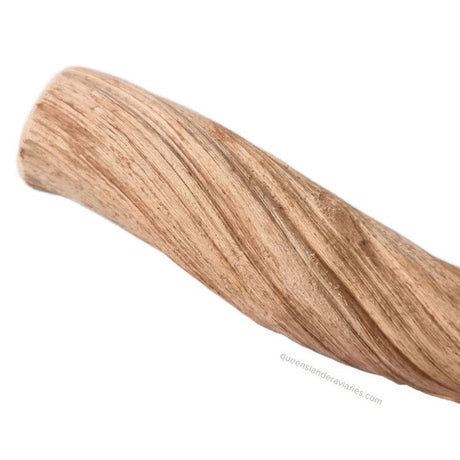

Most cages come with two round dowels, both the same thickness, and plenty of birds are still standing on them years later. The fix is simple enough: make sure no two perches in the cage are the same. Three cheap perches that are all different will do more for a bird than one expensive one.
Here is what to put in, what to take out and where it all goes.
Jump to A good perch setup, Natural branches, Flat perches, Rope perches, Calcium and pumice, Where they go, Cleaning or Common Perch Questions.
What does a good perch setup look like?
The aim is variety rather than quantity. A bird's foot closes to whatever it is standing on, so a cage full of identical dowels means the same grip, the same angle and the same pressure points all day. Give it a thick branch, a thinner one and something flat, and the foot has to keep working.
Three or four perches suits most cages. One natural branch as the main perch, one flat surface near where the bird eats, and something soft or flexible to move around on covers nearly everything a bird does in a day. A mineral perch is a useful extra rather than one of the core three. Past four or five you start crowding the cage, which causes its own problems.
The dowels do not all have to go. Pulling one out and leaving the other gives the bird a choice it did not have before, which is the point of the exercise. Adding one perch at a time and watching which ones actually get used tells you more than buying a full set on day one.
Are natural branches better than dowel perches?
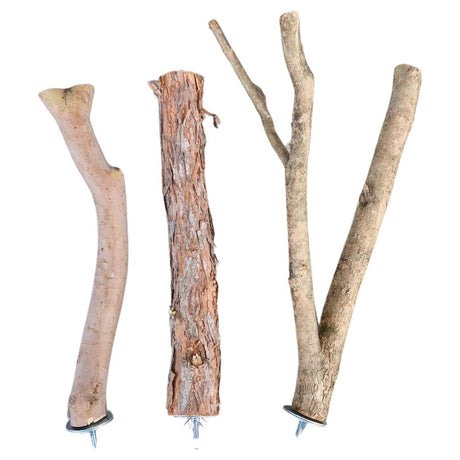
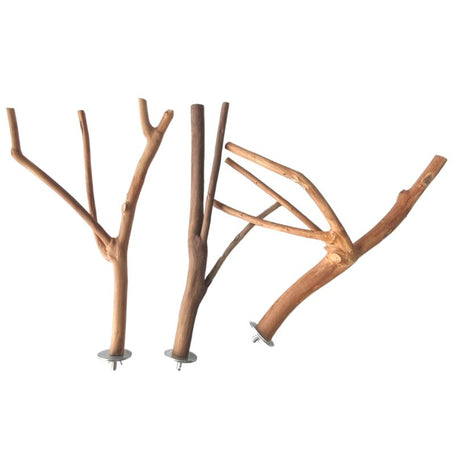
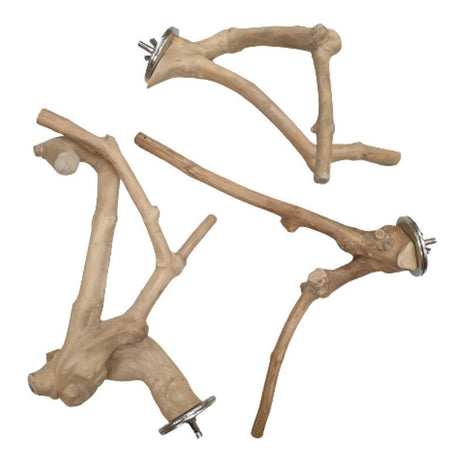
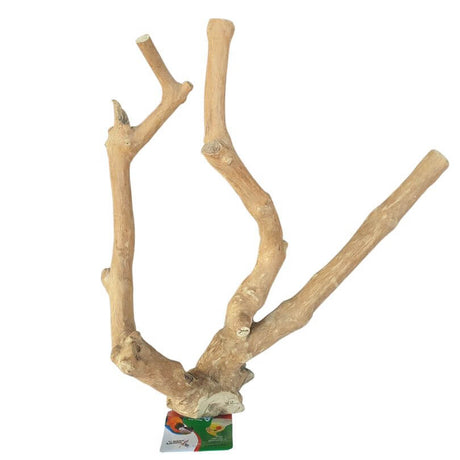
A dowel is turned on a lathe, so it is the same diameter along its whole length and sanded smooth. A branch tapers, bends, carries knots and rough patches, and the bark gives the foot something to hold. That irregularity is the whole point of buying one.
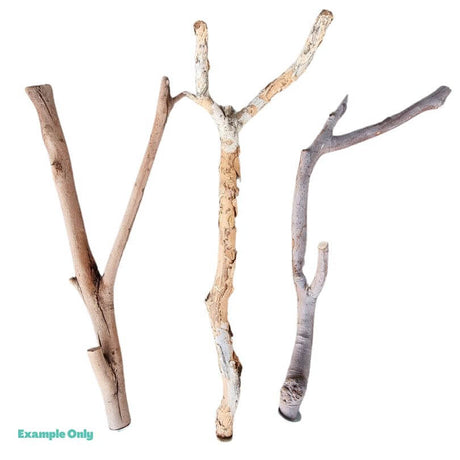
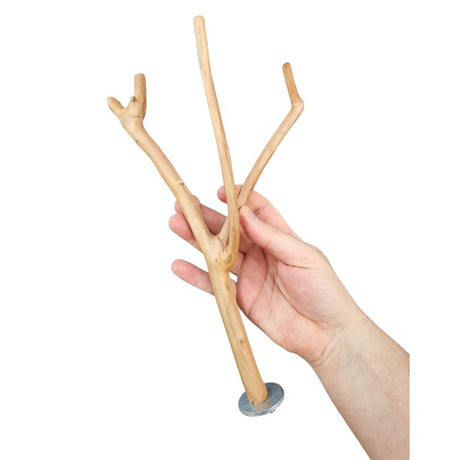
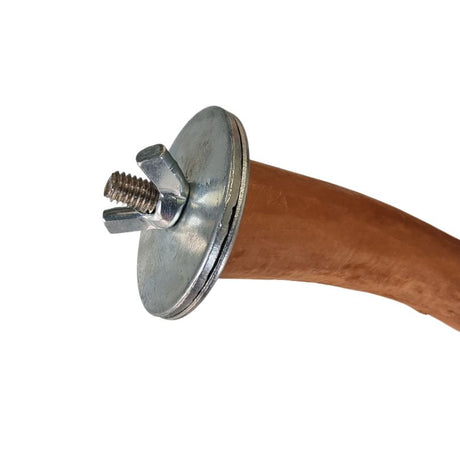
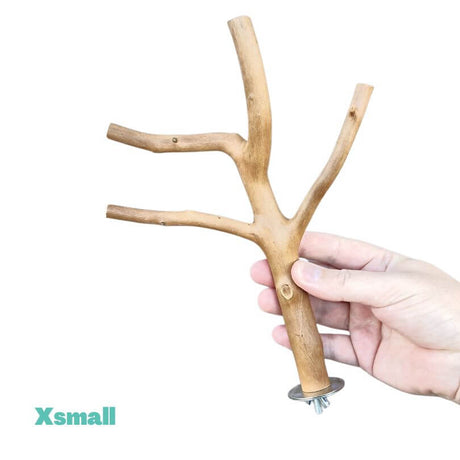
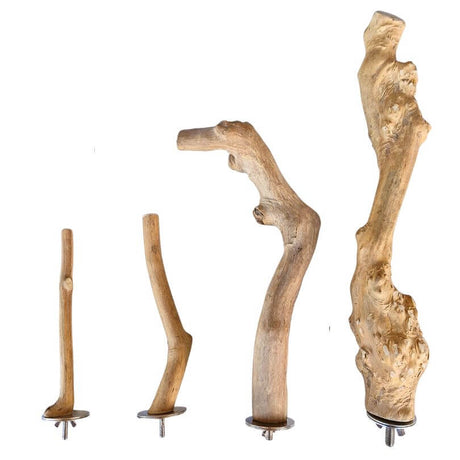
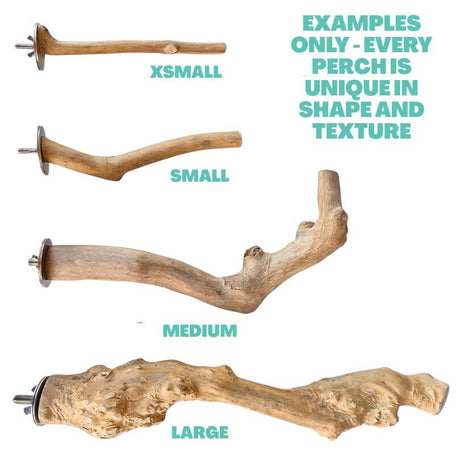
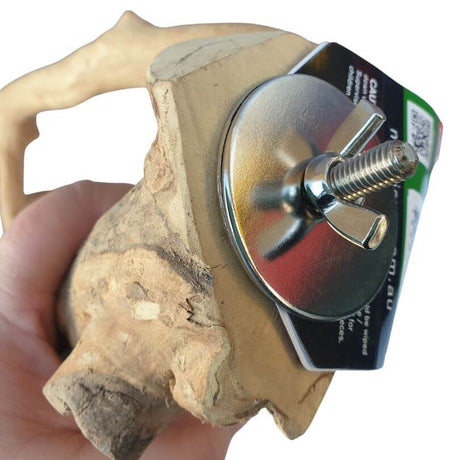
 The Aussie Bush Perches are sustainably sourced Australian native timber, sold individually, and come off by hand with a wing nut so you can move or clean them without tools. The two sizes differ in thickness rather than length, with Small suiting birds from Cockatiels up to Ringnecks and Large suiting Alexandrines, Eclectus and larger. Budgie and Macaw thickness are both available on request, and if you want something with a particular shape or plenty of bark left on it, send us a message and we will pick one out.
"Amazing quality. Love the rough bark. Great texture and great size being large for my eclectus parrot. Great for his foot health and grip. He loves it so much he was doing flips on it : )"
Alexandra J., verified buyer, Eclectus
Expect the bark to come off. A bird stripping a perch is using its beak on something that is not your skirting boards, and natural wood is partly consumable for that reason. If yours goes through a branch in a fortnight, a harder timber is the answer rather than a bigger one, and the Java Wood Perches hold up considerably longer under the same beak. The same trade off runs through toys, which we go into in my bird destroys every toy.
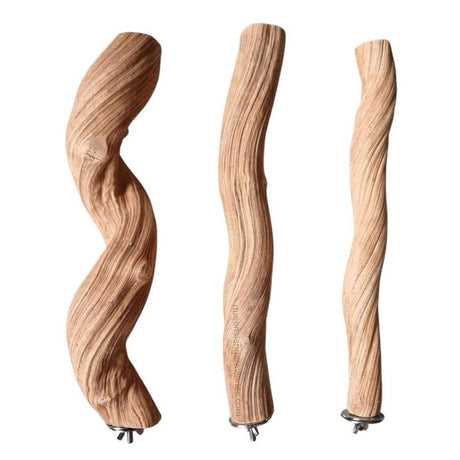
Once you have one branch in, a second perch at a different thickness is where the variety comes from. The Natural Vine Perch does that in a single piece, since it is twisted rather than straight and the diameter changes along its length, so the bird picks whichever part suits it. For smaller birds the Beak Joy Natural Apple Tree Wood Perch sits a step under the Small bush perch and costs about ten dollars.
Does my bird need a flat perch?
Flat perches tend to get bought as an afterthought and then turn out to be the most used thing in the cage. Birds eat on them, crack seed on them, hold food in one foot on them and often sleep on them, all of which are awkward on a round perch.
"Our parrots love their platforms. They love to crack seeds on it and they prefer to eat their food on it as it's a flat surface. It's a parrot thing."
Naomi E., verified buyer, Galah and Cockatiel
 Where you put one matters more than which one you buy. Sited next to the food bowls it gets used at every meal, which is usually the fastest way to get a bird to accept a new perch at all. A cross section of real timber like the Birdnerd Gum Slice Platform Perch gives a natural surface with bark still on the rim, and for a bigger bird the solid Java Platform Perches are heavy enough not to shift on landing.
 The cardboard version does two jobs at once. The Avian Care Cardboard Platform is a thick slab with beads set into it, so it works as a standing surface and as something to destroy, and owners hide treats in the bead holes to turn it into a foraging tray. There is a Mini version for smaller cages. Treat it as a consumable, because some birds pick at one for weeks and others go through the whole thing in a couple of days. The rest of the range sits in the platform perches collection.
Are rope perches good for birds?
Rope is the one that gets birds moving. It gives under the foot, so the bird has to balance and shift its grip rather than lock into one position, and it can be bent into a curve or an arch to cross parts of the cage a rigid perch cannot reach.
"My peach faces love this flexible perch. They spend much more time moving around on it than they do on their timber perches."
Donna R., verified buyer, Lovebird and Peach Face
 The Sisal Flexi Perch is bird safe sisal with a wire centre, so it holds whatever shape you bend it into and fixes to the bars at both ends with a wing nut. The Sisal Rope Boing hangs from a single hook instead and keeps its spring, which suits a bird that likes to bounce rather than walk.
Rope does need watching. Sisal frays with use, and long loose strands are worth trimming back before a bird gets a toe caught in one. A rope perch that has gone thin and stringy has reached the end of its life.
Are calcium and pumice perches good for birds?
These have a rough mineral surface and are sold on the basis that they help keep nails and the beak in trim. They do take the edge off a nail tip over time, though they are not a substitute for a proper nail trim.
 They work best as an occasional surface rather than a main perch. A bird resting on an abrasive surface for long stretches, particularly overnight, is more likely to end up with sore feet, so a mineral perch is better placed at mid cage height than at the top where a bird is most likely to settle for the night. Used that way it gets short visits through the day, which is what it is for. The Calcium Platform Perch is the heavier option and the Lava Platform Perch is pumice and much lighter.
Where should perches go in the cage?
Height sorts out most of it. Birds tend to settle on the highest perch to sleep, so droppings collect under it overnight and anything directly below gets soiled. Keep food and water bowls out from underneath, and avoid putting a cardboard platform there unless you want to keep replacing it. If the cage floor is already a mess, our article on cutting food waste is worth reading alongside this.
Leave the middle of the cage reasonably clear. It is easy to fill a cage so completely that the bird cannot open its wings, and one that has to climb everywhere rather than fly loses a lot of daily movement. Perches at the back and sides with a run across the middle gives it somewhere to go.
Beyond that, set them at different heights rather than in a line, keep the flat one near the food, and run the rope perch across a corner or a diagonal where a rigid perch would not fit. Everything with a wing nut comes off by hand, so rearranging things a week later costs nothing and often fixes a perch the bird has been ignoring. You can see the full range in the perches collection.
How do you keep perches clean?
Perches get dirty faster than most people expect, particularly the flat ones and anything sitting under a favourite spot. Taking them off the cage is the whole reason the wing nut fitting matters.
Scrape the solids off first, then scrub with hot water and let the perch dry completely before it goes back in. Bark and rope both hold moisture, and a damp perch returned to a cage is an invitation to mould, which is worth avoiding for the reasons covered in our article on protecting your bird from mould. If you want to use something stronger than water, our guide to safe disinfectants for cages covers what is sensible and what to keep away from birds.
Not everything is worth cleaning. Cardboard platforms are not washable and are meant to be replaced, and a wooden perch that has been soaked, stained and chewed thin has done its job.
Common Perch Questions
How many perches should a bird cage have?
Three or four suits most cages, offering a choice of diameters and surfaces without filling the space so much that the bird cannot stretch its wings. One natural branch, one flat perch and something flexible is a good starting combination.
Where should a calcium or pumice perch go in the cage?
Mid cage height rather than at the top. Birds tend to settle high up for the night, and a mineral perch is better used in short visits through the day than slept on for hours at a time.
Are sandpaper perch covers a good idea?
They are widely advised against. The sandpaper sits against the underside of the foot constantly and wears the skin rather than the nail. A mineral perch at mid height is the more sensible version of the same idea.
Can I use a branch from my garden as a perch?
Only if you know the tree is a suitable species and that it has not been sprayed. Give it a good scrub and let it dry fully first. Our guide to bird safe plants and branches covers which ones are worth cutting.
Is it normal for my bird to chew its perch?
Yes. Stripping bark and whittling the ends is normal beak use. Check the mounting end every so often and replace the perch once it has been chewed thin or worn smooth along its whole length.
My bird will not go near a new perch. What should I do?
Give it a few days, since birds are suspicious of anything new in a familiar cage. If it is still being avoided after a week, move it somewhere the bird already goes, such as beside the food bowls, and put a favourite toy next to it.